Brain MRI
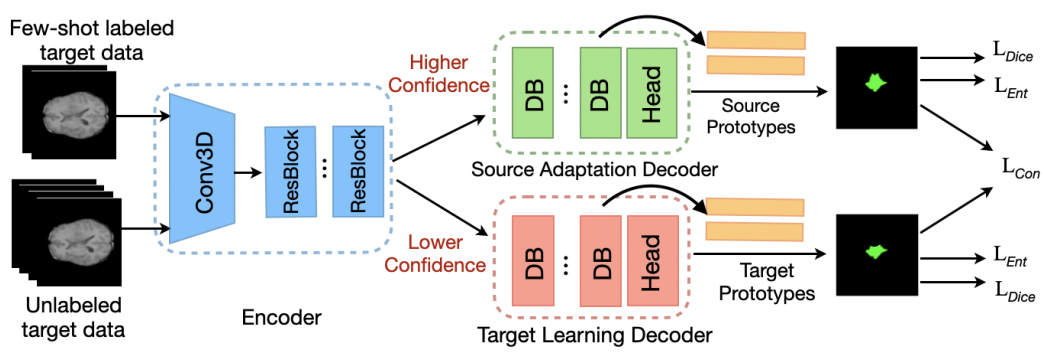
Source-free Few-shot Segmentation for Rarer Brain Tumors | Link in here
Although existing brain tumor segmentation methods achieved promising results, they mostly focus on glioma segmentation, largely due to their relatively high incidence. These fully-supervised methods may not be applicable as they rely on abundant labeled data, which is intrinsically inaccessible for rarer types of brain tumors. Data-efficient transfer learning approaches like few-shot learning and domain adaptation assume full access to source data, which may not be feasible in real-life scenarios due to privacy and confidentiality concerns. In this work, we propose a new source-free few-shot learning framework for rarer brain tumor segmentation that adapts source model trained on gliomas to other less common brain tumors such as meningioma, metastasis and pediatric tumors with only a few labeled target data. The proposed framework follows a dual-branch prototypes learning structure that harmonize preservation of common knowledge from source class and learning new features from target.
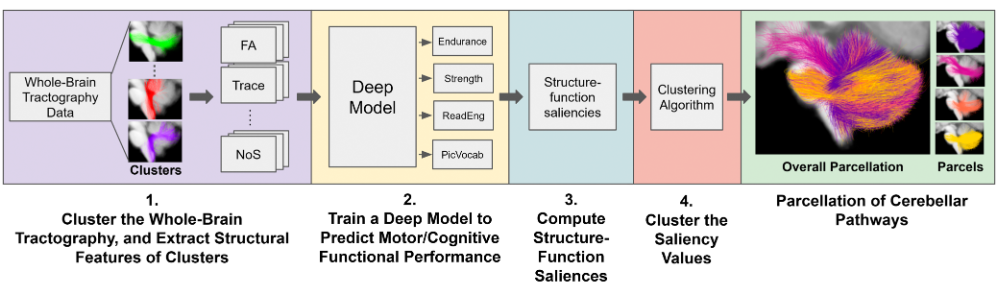
Deep Multimodal Saliency Parcellation of Cerebellar Pathways: Linking Microstructure and Individual Function Through Explainable Multitask Learning | Link in here
In this work, we propose a multimodal data-driven method for cerebellar pathway parcellation, which incorporates both measures of microstructure and connectivity, and measures of individual functional performance. Our method involves first training a multitask deep network to predict various cognitive and motor measures from a set of fibre tract structural features. The importance of each structural feature for predicting each functional measure is then computed, resulting in a set of structure–function saliency values that are clustered to parcellate cerebellar pathways. We refer to our method as Deep Multimodal Saliency Parcellation (DeepMSP), as it computes the saliency of structural measures for predicting cognitive and motor functional performance, with these saliencies being applied to the task of parcellation.
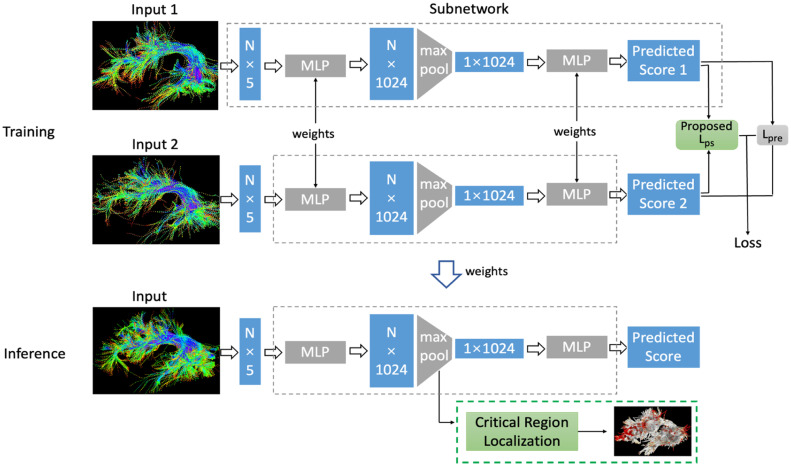
TractGeoNet: A Geometric Deep Learning Framework for Pointwise Analysis of Tract Microstructure to Predict Language Assessment Performance | Link in here
We propose a geometric deep-learning-based framework, TractGeoNet, for performing regression using diffusion magnetic resonance imaging (dMRI) tractography and associated pointwise tissue microstructure measurements. By employing a point cloud representation, TractGeoNet can directly utilize tissue microstructure and positional information from all points within a fiber tract without the need to average or bin data along the streamline as traditionally required by dMRI tractometry methods. To improve regression performance, we propose a novel loss function, the Paired-Siamese Regression loss, which encourages the model to focus on accurately predicting the relative differences between regression label scores rather than just their absolute values. In addition, to gain insight into the brain regions that contribute most strongly to the prediction results, we propose a Critical Region Localization algorithm. This algorithm identifies highly predictive anatomical regions within the white matter fiber tracts for the regression task.