Machine Ethics
Generation of Ethical Rules Using Large Language Models | Link in here
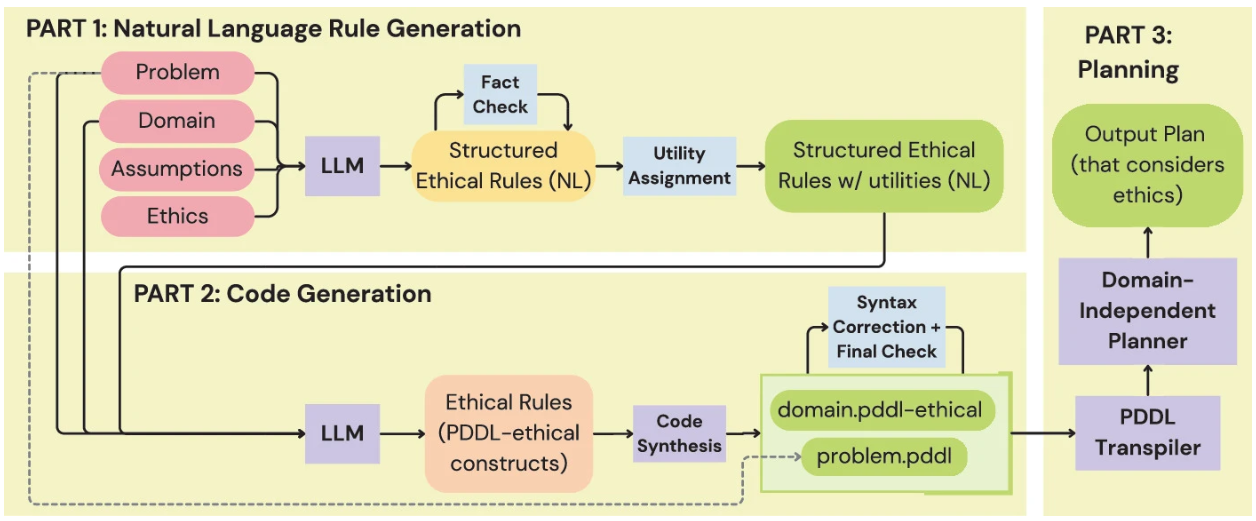
Robots require ethical sensitivity, not just functional competence, to make decisions in human settings. While AI planning generates action sequences for goals, few approaches incorporate ethical rules. Manually defining such rules is context-specific and time-consuming, and to our knowledge, no work automates this process. We propose a pipeline that uses Large Language Models (LLMs) to generate context-specific ethical rules grounded in high-level principles like privacy and beneficence. Rules are generated by an LLM and compiled into action costs, enabling classical planners to produce ethically informed plans. We evaluate our pipeline on nine ethical planning scenarios across three domains. Rule generation achieves an average Sentence-BERT similarity of 0.82, while code generation succeeds in 82.2% of cases with minimal manual edits. This work presents a novel approach to automating ethical rule generation, enabling context-based ethical decision-making.
Formalisation and Evaluation of Properties for Consequentialist Machine Ethics | Link in here
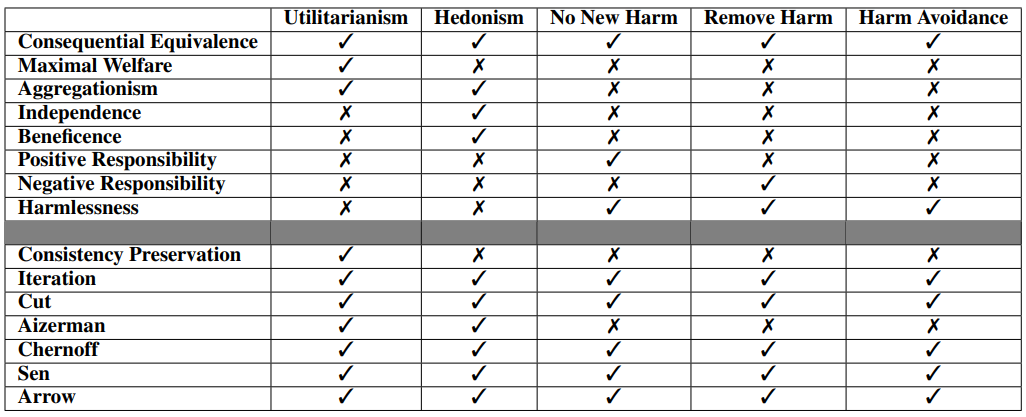
As artificial intelligence (AI) technologies continue to influence our daily lives, there has been a growing need to ensure that AI enabled decision making systems adhere to principles expected of human decision makers. This need has given rise to the area of Machine Ethics. We formalise several ethical principles from the philosophical literature in the situation calculus framework to verify the ethical permissibility of a plan. Moreover, we propose several important properties, including some of our own that are intuitively appealing, and a number derived from the social choice literature that would appear to be relevant in evaluating the various approaches. Finally we provide an assessment of how our various situation calculus models of Machine Ethics that we examine satisfy the important properties we have identified.